
What Happens If You Stop Paying for Your Life Insurance?
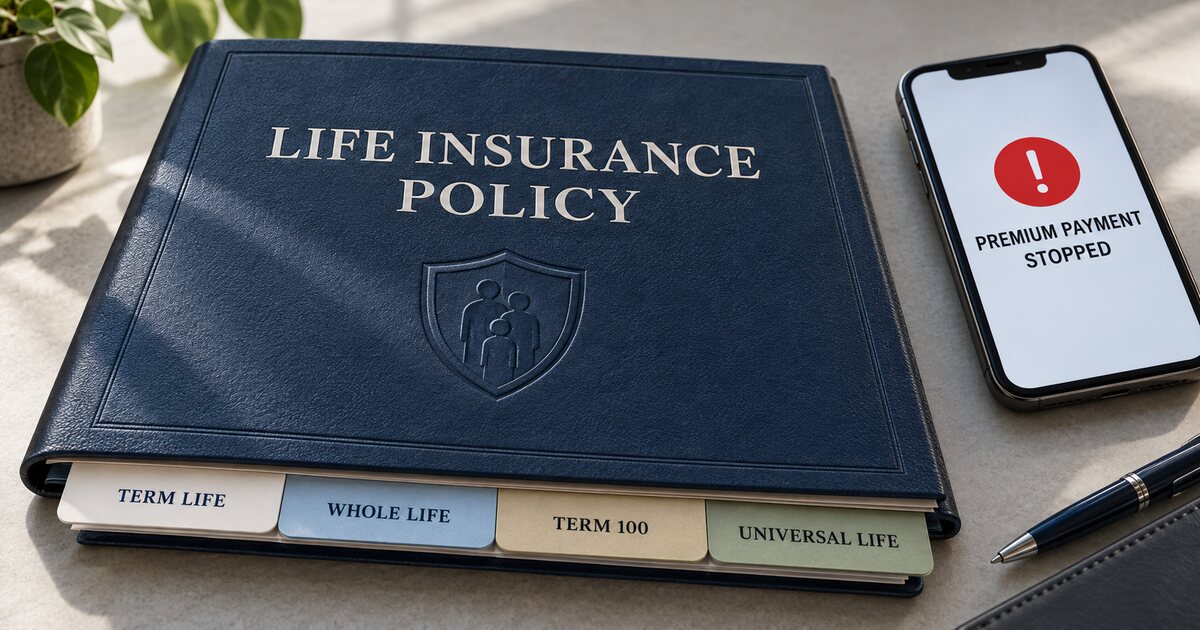
Stopping your life insurance payments does not always cause the policy to end immediately. What happens next depends largely on the type of policy you own and whether it has cash value or contractual provisions that can keep it in force.
With Term Life Insurance, the outcome is straightforward. With permanent insurance, the policy can continue by borrowing against its cash value, using dividends, converting to reduced paid-up insurance, or deducting charges from an accumulated policy fund.
Understanding how your particular policy works is essential before deciding to stop making payments.
What Happens to Term Life Insurance?
Term Life Insurance does not accumulate cash value. If you stop paying the premiums, the policy remains active during the grace period stated in the contract. If the overdue premium is not paid before the grace period ends, the policy lapses and the coverage terminates.
Once the policy has lapsed, there is no death benefit and no accumulated value to return to the owner.
A lapsed policy can sometimes be reinstated, but reinstatement can require overdue premiums, interest, and new evidence of insurability. For a more detailed explanation of grace periods, reinstatement, and the consequences of losing coverage, read What Happens When a Life Insurance Policy Lapses?.
Permanent Insurance Does Not Always Lapse Immediately
Permanent Life Insurance is intended to provide lifelong protection, but permanent does not mean that premium payments can simply be stopped without consequences.
Whole Life policies contain non-forfeiture options that preserve the policy and some of its benefits when premiums are no longer paid. Depending on the option used, the policy can borrow against its cash value or continue as a smaller amount of fully paid-up insurance.
Participating Whole Life can also use dividends to offset premiums. Universal Life can use its accumulated policy fund to cover monthly insurance costs and other charges.
Term 100 is also permanent insurance, but it does not have cash value. If the owner stops paying the required premium, the policy remains active during the grace period and then lapses if the overdue amount is not paid.
Whole Life Insurance and Automatic Premium Loans
Whole Life policies contain an automatic premium loan provision as one of their non-forfeiture options.
If a required premium is not paid, the insurer automatically lends the policy the exact amount of the unpaid premium, using the policy’s cash value as collateral. This keeps the insurance in force as long as sufficient value remains.
For example, if the monthly premium is $250 and the payment is missed, the policy creates a $250 loan to pay that premium. If the next monthly premium is also missed, another $250 is added to the loan.
Interest is charged on the outstanding balance according to the rate established in the contract. As additional premiums are missed, the loan and accumulated interest continue to grow.
An outstanding policy loan reduces the death benefit dollar for dollar, including the accumulated interest. If the insured dies with a $20,000 loan balance, the insurer first repays that loan from the policy and the beneficiary receives $20,000 less.
If the loan and accumulated interest eventually use all the available cash value, the policy lapses. Depending on the policy’s adjusted cost basis and the size of the outstanding loan, the lapse can also create taxable income even though the owner did not receive any new money at that time.
An automatic premium loan prevents an immediate lapse, but it is not free insurance. The policy is borrowing against its own value to make each required premium payment.
Reduced Paid-Up Insurance
Whole Life policies also include a reduced paid-up insurance option.
The policy contract contains a table showing the guaranteed reduced paid-up death benefit available at the end of each policy year. Unlike an automatic premium loan, this option does not happen automatically. The owner must apply to exercise it.
For example, someone may have a $500,000 Whole Life policy with an $80,000 cash value. The policy’s guaranteed values may provide a reduced paid-up death benefit of $150,000 at that point.
By exercising the option, the owner permanently gives up the remaining $350,000 of coverage. The policy continues with a $150,000 death benefit, the existing cash value remains in the policy, and no further premiums are required.
Reduced paid-up insurance is a permanent decision. It allows the owner to stop paying premiums while preserving a portion of the death benefit for the beneficiaries, without accumulating automatic premium loans or creating a taxable disposition.
Participating Whole Life and Premium Offset
A participating Whole Life policy can eventually reach premium offset.
Participating policy dividends are normally used to purchase paid-up additional insurance. These additions increase the policy’s death benefit and cash value over time.
Once the policy’s dividend values become large enough, the owner can redirect the dividends toward paying the required premium instead. This is called premium offset.
The premium still exists and must still be paid. The difference is that the payment comes from the policy’s dividends and accumulated dividend values rather than from the owner’s bank account.
Because the dividends are being used to pay premiums instead of purchasing more paid-up additional insurance, the policy’s death benefit and cash value will not grow as quickly as they would if the original dividend option continued.
Premium offset is not available immediately after the policy is purchased. It normally takes years for the policy to build sufficient dividend values. The date shown in the original illustration is not guaranteed because participating policy dividends are not guaranteed.
If dividends decrease and are no longer sufficient to cover the full premium, the owner must resume some or all of the out-of-pocket payments. If the required premium is not paid, the automatic premium loan provision applies.
What About Term 100 With Values?
Some insurers market a product called Term 100 with values. Despite the name, this is not another category of life insurance and it is not traditional Term 100.
Term 100 with values is a non-participating Whole Life policy. It has guaranteed cash values and the same Whole Life provisions described above, including automatic premium loans and a guaranteed reduced paid-up option.
The words “Term 100 with values” are simply the product name. For the purpose of understanding what happens when premium payments stop, it should be treated as Whole Life Insurance.
Universal Life Uses the Policy Fund Differently
Universal Life works differently from Whole Life.
Premium payments are deposited into the policy’s investment accounts after applicable deductions such as premium tax. The insurer then deducts the cost of insurance and other policy charges from those accounts each month.
If the owner stops making payments but the policy has enough accumulated value, the monthly deductions continue coming from the policy fund. This keeps the coverage in force without creating a policy loan.
The distinction is important. Under an automatic premium loan on Whole Life, the policy borrows the full amount of each unpaid premium and charges interest on the loan. Under Universal Life, the insurer deducts only the monthly cost of insurance and other applicable charges from the existing policy fund.
Those monthly deductions can be only a fraction of the amount the owner was previously depositing.
For example, an owner may have been depositing $500 per month while the policy’s monthly insurance costs and other charges total $150. If the owner stops making deposits, the policy does not deduct the previous $500 payment from the fund. It continues deducting the required $150 in monthly charges.
What happens to the policy fund after payments stop depends on the investment performance compared with the monthly deductions. The fund can decrease, remain relatively stable, or continue growing.
The period during which the owner can stop making payments while the policy fund covers the monthly deductions is often called a premium holiday. Depending on the accumulated value, investment performance, and cost-of-insurance structure, a premium holiday can last several years or even decades.
Some insurers provide projections showing how long the current policy value can support the monthly deductions under specific assumptions. These projections should be reviewed periodically because actual investment performance and future policy charges determine how long the premium holiday can continue.
If the policy fund eventually becomes insufficient to cover the required monthly deductions, the owner must contribute additional money to prevent the policy from lapsing.
Before You Stop Paying, Find Out What the Policy Is Actually Doing
A permanent policy can remain active after payments stop, but the way it remains active matters. The policy could be accumulating a loan, using dividends that would otherwise purchase additional insurance, converting to a smaller paid-up death benefit, or using its Universal Life policy fund to cover monthly deductions.
Before changing or stopping payments, request a current policy review and confirm:
Whether premiums are still contractually required
Whether automatic premium loans have already started
The balance and interest rate of any policy loan
Whether premium offset is currently available
The guaranteed reduced paid-up death benefit available
Whether a Universal Life premium holiday is available
How long the Universal Life policy fund is projected to support the monthly deductions
Pedro Diaz Ramos can help you review your current policy, explain which provisions apply, and obtain updated information from the insurer. This allows you to understand the consequences before making changes that could affect your policy’s values or lifelong coverage.




Have questions about your insurance or investment options?
Get personalized advice from Pedro and find the right solution for you and your family